

By: Darren Durlach
A respected DP and filmmaker I follow gave a glowing review of Eddie A.I., an editing platform promising to handle rough cuts like an assistant editor. It claims to process hours of footage quickly, generate stringouts, and essentially give you a head start on your edit.
As someone producing docuseries content with hours of footage, brutal deadlines, and endless rounds of revisions, I was intrigued. If Eddie A.I. could deliver solid stringouts faster, that would mean getting to a rough cut sooner — which means more time to polish and more time for our producers and editors to flex creative muscle.
So I put it to the test. This is by no means an in-depth test, but enough to know whether I wanted to continue using it.
Test #1: Talking Head Video 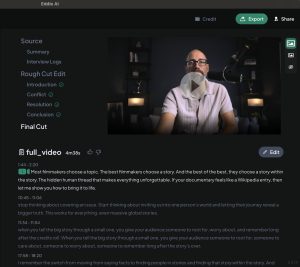
This is truly the easiest assignment. First, I fed Eddie a 30-minute YouTube video of me talking to camera. It was scripted, so I gave a simple prompt:
“Follow the natural progression of the dialogue, take the best takes, remove redundancy, and keep it logical.”
Sounds easy enough — cut long pauses, remove repeats.
What I got back? A strange, disjointed sequence. It cut sentences mid-thought, kept in long pauses, and rearranged sections in ways that didn’t make sense.
I wasn’t expecting perfection or even anything very good. I just wanted solid – the edits were clean, it flowed in a natural progression, etc… Every A.I. requires a human to refine it and my own opinion is that will never change. But this was pretty bad.
I spent 30 minutes prompting it to make improvements and fix the sequence before realizing I could have built the stringout myself in the same time.
Fail.
 Test #2: Two-Camera Interview
Next, I tried an hour-long, unscripted two-camera interview and it has a ‘mult-cam’ mode. This seemed like the perfect scenario for A.I. to shine — lots of material to sift through, no fixed script. My scripted Youtube video honestly was so easy to do myself and it really didn’t even feel necessary to use to A.i.
This one though requires more time. The answers don’t need to be linear and it can really move soundbites around and determine what stuff can work and what was extraneous.
Again… nope. I got all kinds of weird franken-bite soundbites that didn’t fit together well, were cut at odd times in the middle of thoughts and didn’t really work. It required too much back-and-forth prompting, and the time savings weren’t there. Plus, I found myself getting frustrated with it.
The other issue too is that it didn’t cut from one angle to the other. It just stayed on one angle even though it claimed to be a multi cam editor. If this worked, it would’ve saved me time, too because it’s a basic task of simply cutting to whoever is talking and mindless for an editor to do.
What It Did Well
I want to be fair. This was not an extensive deep test. It’s quite possible that I’m spoiled by the ease of text-based A.i. like Chatgpt and didn’t take the time to understand the nuances of this.
And there are a lot of other features with Eddie A.I. that look interesting. It can cut social media clips (but many other can do it too). It logs A/Broll and labels each clip with meta data and a title that is searchable. I didn’t try to this but demos online did appear to be spookily accurate. Like it knew exactly what each raw video clip included and was able to give very accurate titles. I could see this helping with organization and finding media.
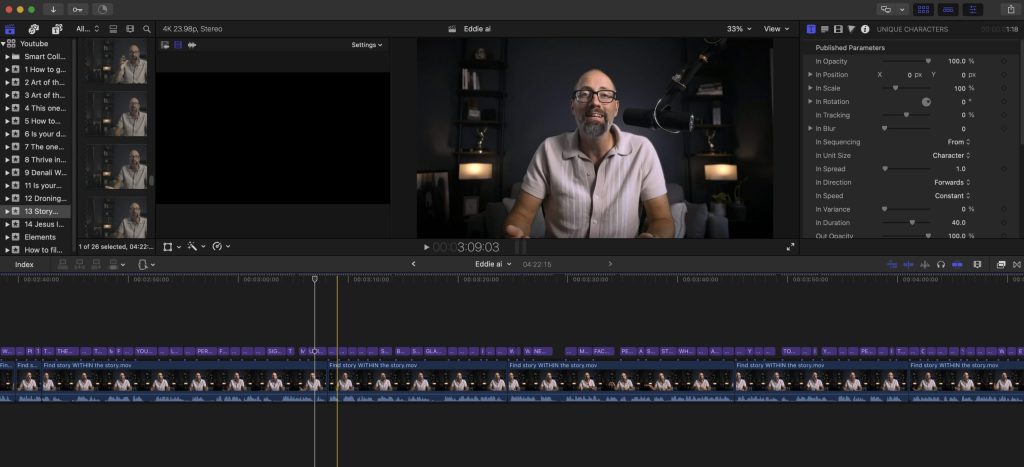
The uploads were faster than any cloud platform I’ve used. Processing time was very quick. Exporting timelines to Premiere or Final Cut Pro was seamless. A 22 gb hour-long video clip took only minutes to upload and process which was impressive.
For my YouTube workflow in FCP X, the exported timeline was tidy, with captions over each soundbite for searchable navigation — a genuinely nice touch.
The Verdict (For Now)
AI editing tools like Eddie A.I. are still in their early days. Right now, it’s more interesting toy than trusted assistant. I see potential — enough that I’ll keep experimenting, maybe on smaller YouTube projects — but it’s not ready for the high-pressure demands of network TV post-production or even corporate work.
If there’s one upside to all this A.I. hype, it’s this: the more I test, the more I’m convinced that human creativity, judgment, and storytelling instincts aren’t going anywhere. Tools will change. Deadlines will always be tight. But for now, the editor’s chair is still firmly occupied by… editors. And I may be in the minority, but I believe they always will be.
Need editing??? Reach out to our humans. They don’t mess around.